
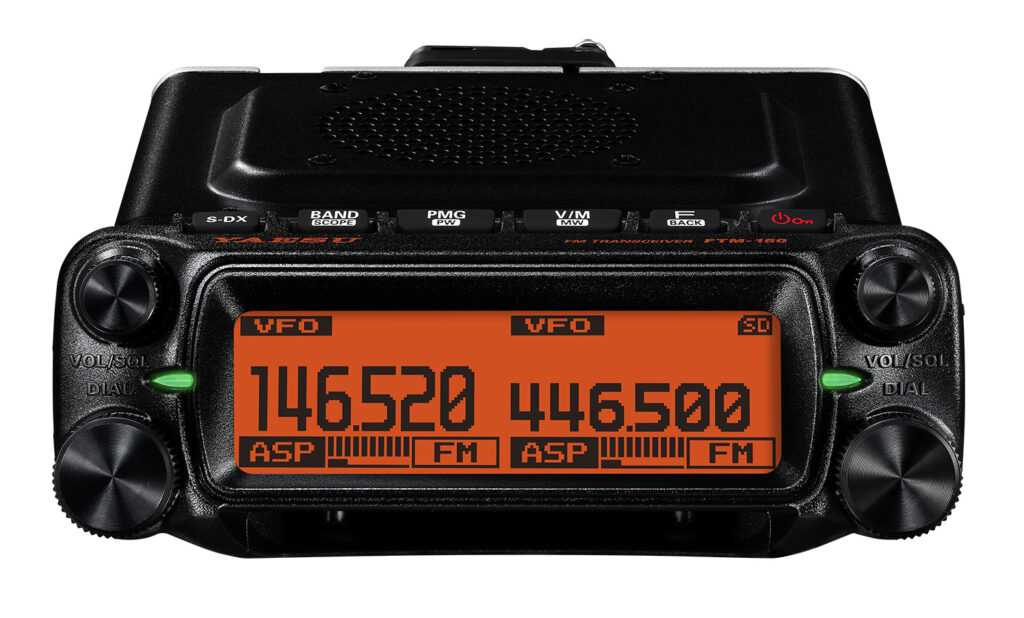
Last week I ordered a new Yaesu FTM-150RASP. It delivered on the 14th, but I was away from home for a couple of days, so I had to be an adult and show some patience.
This morning (2 days after delivery) I finally got to to come home and open it. I’m not really into “first impression” videos, so I’ll just tell you about it. First off, if heft is any indication of quality, then this radio must be of the highest quality. This is a remarkably heavy radio for how big it is. After handling a couple of similarly sized, but much lighter, Chinese radios, this was a bit of a surprise. The folks at Yaesu really wanted to be able to get rid of some heat.
Hooking it up is pretty straight forward, no surprises there. The first thing I wanted to do was change the display from the old school orange to white. I saw in a video from the “Ham Radio 2.0” You Tube channel that it could be done. The 5 buttons on the top of the radio aren’t quite as intuitive as I expected. Maybe if I had some experience with a modern Yaesu then I might have been able to find things a little easier, but since this is my first new radio, straight to the owners manual I had to go! After fixing the display color, I just needed to figure out how to program it.
If you’re not familiar, this radio is almost like having 2 radios in one. It has 2 volume knobs, and 2 VFO knobs. It is possible to simultaneously listen to VHF + VHF, or UHF + UHF, or VHF + UHF at the same time. Rolling the VFO to change the channel is easy enough, OR, you can just type the frequency you want on the key pad on the mic. However, figuring out how to program the CTCSS codes took me a while. The 35 year old Yaesu that I had been using did not program like this radio AT ALL. After scrolling through the menu for a while, and not finding anything labelled CTCSS, I finally found a reference that I needed to change the ‘SQL TYPE’ from ‘none’ to ‘TONE ENC’. This is on sub menu 33! From there, you go to sub menu 34 to chose the actual ‘TONE SQL FREQ’. Not exactly new user friendly.
However, I’m a big boy, and I do know how to use Google. I managed to figure it out in about 30 minutes. Within 2 hours of cutting the tape on the box, I had managed to program 20 repeaters, had made a few contacts who reported a good signal, and was scanning those channels. I even managed to figure out how to label those channels with names, rather than just frequencies. As I said before, maybe someone with some experience would have made better time.
For the most part, I’m hitting the same 2 meter repeaters that I was hitting with the older Yaesu. I’m getting almost a full 50 watts of output according to my SWR meter, as compared to the 40 that the older radio was putting out, so there’s no shocking news there. However, there is a difference on the 70cm side. The Chinese radio was a dual band, and I tried hitting multiple 70cm repeaters, with no luck. The only time I hit 70cm repeaters was when I was within eyeshot of them in my truck. This is one reason why I seriously considered getting a 2m only radio, because I didn’t think 70cm would be beneficial where I live. With the new Yaesu, I’m hitting a couple of 70cm repeaters about 12 miles away, and another that’s 20. Maybe its the radio… maybe its just good propagation today. Time will tell.
The mounting system for this radio is pretty neat. It has a release lever on it, so you can just pull the whole radio out, without having to unscrew knobs, like an old CB. When you want to put it back in, you just slide it in like a big cartridge, and it will lock back into the bracket. I don’t know if this is a “Yaesu” thing, but I hope all my future radios are as easy to mount and dismount.
Scanning is way faster than the other radio’s I’ve played with so far. You can actually get both sides scanning at the same time, so you won’t miss a thing! This radio does have some channel bank options that I haven’t explored yet, but I do know you can chose to scan all, or only UHF, or only VHF and have both sides of the radio working independently. Since I only have 20 channels that I’m scanning (19 now, since someone keeps sending digital on one repeater), I keep one side scanning, and the other on 2 meter call frequency.
Even though this is a 2m & 70cm radio, it does allow for scanning air bands, and 1.25 meters. I don’t have a lot going on in either of those, except for commercial planes coming in to Atlanta on the air bands. If you want to scan those, it helps to turn the radio to mono band, and turn on the scope to watch for transmission spikes.
I chose this radio for a few different reasons. The first is because you get what you pay for. Yaesu has been around a while, and has a great reputation. As I’ve told in previous blog entries, I’ve had a couple of ‘hand me down’ radios so far. One is a cheap Chinese radio that bit the dust already, and wasn’t more than 2 years old. The other radio is a Yaesu FT-2500 circa mid-90’s. I figure if the 35ish year old radio is still kicking, I might want to chose that manufacturer.
The second reason is for the ASP function. You can get this radio with, or without ASP, but a few weekends ago I got to see it in action and liked it. A friend of mine was showing me his FT-3185 RASP. He liked that radio because of the extra wattage, as he lives quite a ways from where he works. He hit up a repeater and got a response with a bit of static. He turned the ASP on and off, and it really did make a lot of difference. I’ve used mine some already for some distant repeaters, and have had mixed results, but I think overall its worth the extra money. I did seriously consider the FT-3185, especially for the extra wattage, but it is a 2 meter only radio, which leads to the 3rd reason…
The third reason is because I have an interest in working ISS and satellites. Since you can keep one side of the radio on UHF, and the other on VHF, it’s possible to talk on one and hear on the other, if you’re working a cross band repeater. The ISS and other satellites are cross band, so I’ll be able to hear whether I’m hitting them, without having to use 2 radios.
There’s still a lot of functions that I haven’t fully explored, but it took me no more than 2 hours to figure out the basics, and make it usable. While I do think Yaesu could probably do a little better with their user manual, there are plenty of fanboys out there making videos on how to use their equipment, so it’s not like there’s not plenty of resources out there.
Granted, I have very little experience, but so far I’m impressed. I’ll continue to update as I get some more experience with it.