
In my last post, I explained how I was frustrated with my lack of success making HF phone contacts and moved to digital. I thought that digital would be easy to hook up to make sure my equipment worked, and I was wrong. It took me a while, but I finally figured out how to make everything work, and started making digital FT4/8 contacts. At least I knew my radio did work, and that my lack of experience was the reason for not making any phone contacts.
After sporadically using my radio for about a week and a half, and after making around 150 digital contacts, I grew tired of watching a computer, and decided to try phone again. While I was making digital contacts, I noticed that a few that I had made were POTA contacts. That’s when it occurred to me that I could use POTA to know exactly where to find folks, and I knew they would be listening out for me too. This would be much easier than randomly scrolling around looking for someone to contact. Yeah… I know… sometimes I can be a little slow.
So, now I set out with a new plan. A couple of days before Christmas, I used the POTA website to find out where folks were operating, tuned in and listened for a little while. For those of you who may be new also, POTA moves pretty quick. Folks like to make their contacts then move along, and there’s a certain cadence that most contacts seem to move to. Once I felt like I could have a brief conversation, without screwing things up, I keyed up and answered someone calling CQ, and immediately got a response. My first contacts were in Missouri, Virginia, New Hampshire and Iowa. To me, this was a good sampling, from lots of different places. That first day I made 25 contacts, all but 3 were POTA. The other 3 were some random contacts I scrolled by when changing frequencies.
Since then, I’ve made 160 logged phone contacts, with 135 of those being POTA, and Ive managed to make contacts on all of the ham bands from 10 to 80 meter, as well as 3 other countries (Canada, Puerto Rico, and Bermuda). All of these contacts have come from that 20 meter dipole strung up in the trees in my front yard. I’m amazed that I’ve been able to make all of those contacts off of a cobbled together antenna, and 20 watts.
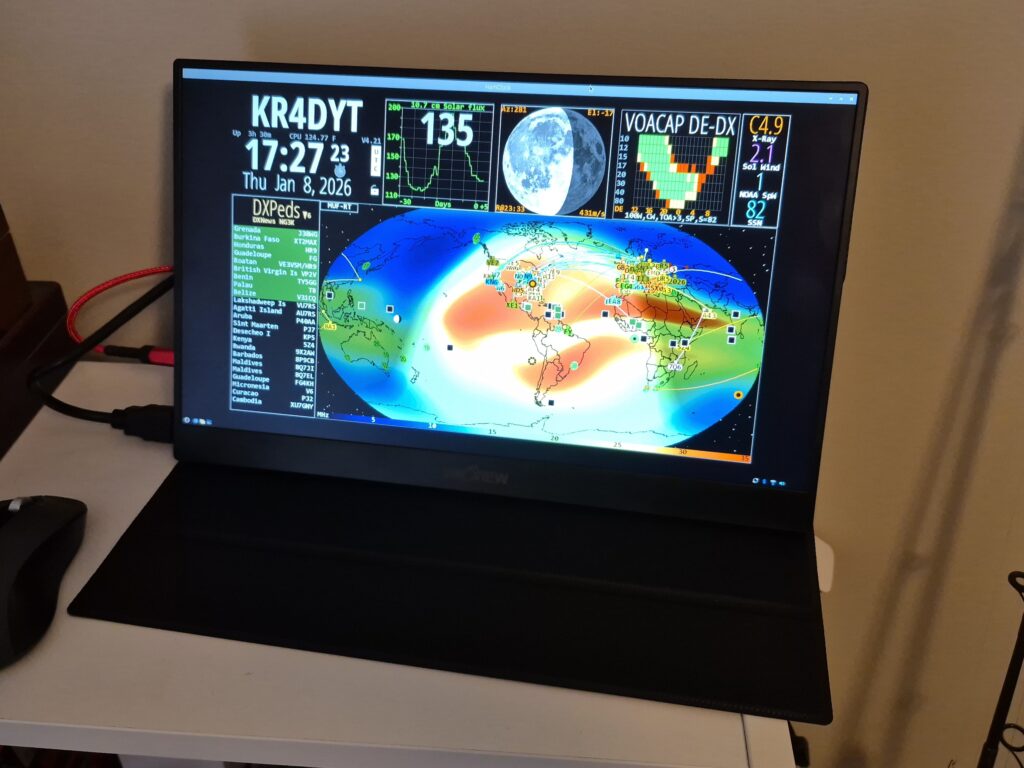
Speaking of 20 watts, I’ve also been surprised at how well I’ve done with my little G90. I’ve managed to break through numerous pile-ups and get heard by POTA activators. Sometimes it takes a few tries, sometimes they hear me on my first try. I get generally great reports back. The one thing that I have noticed is that while I’ve made some distant contacts, I haven’t made those super long DX contacts yet. I’ve tried. I can hear lots of European and Australian stations, but I can’t seem to reach them. I’m sure that’s because of my antenna, so very soon I’ll be trying new things. A very generous friend of mine gifted me a NANO VNA recently, so I’ll be able to tune my antennas better. I also built a HamClock this week from a Pi Zero, and a portable monitor. It gives a ton of information that I don’t understand yet, but I’m hoping that it will eventually help me to better understand the band conditions, and what I can expect. Maybe I’ll post later about building the HamClock, as well as how I’m using the NanoVNA.
Finally, I have to mention my awesome, wonderful wife for being very patient and understanding about this new hobby. December is a pretty slow time of year for my part time work, so I usually have some extra time on my hands, which was spent almost exclusively playing with my new radio, and usually pretty late into the evening. One thing I’ve figured out about ham is that it is easy to get sucked in, and the next thing you know you’ve spent a whole afternoon (or an entire day) working the bands. I love my wife, and am glad she is such a wonderful, understanding, supportive and loving woman!!! Seriously… I do have the best wife ever.
Until later, 73 y’all, and happy POTA hunting!